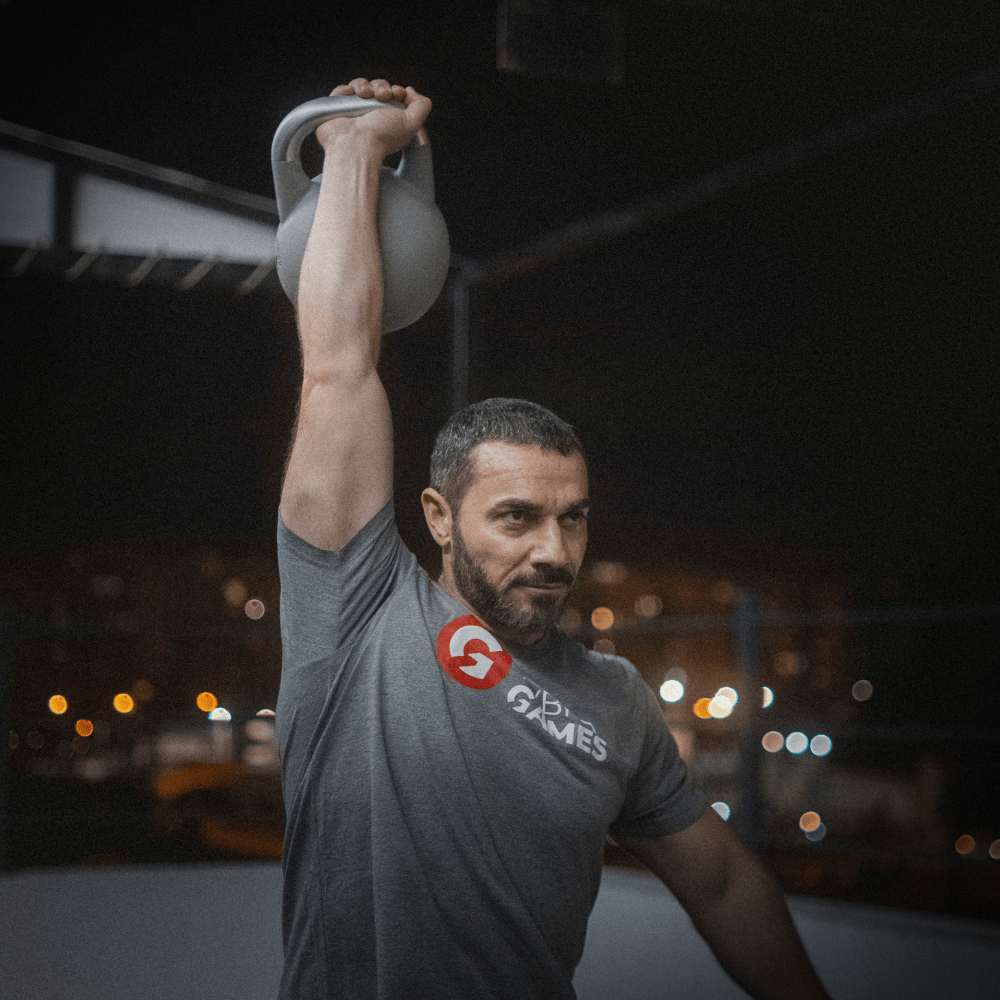
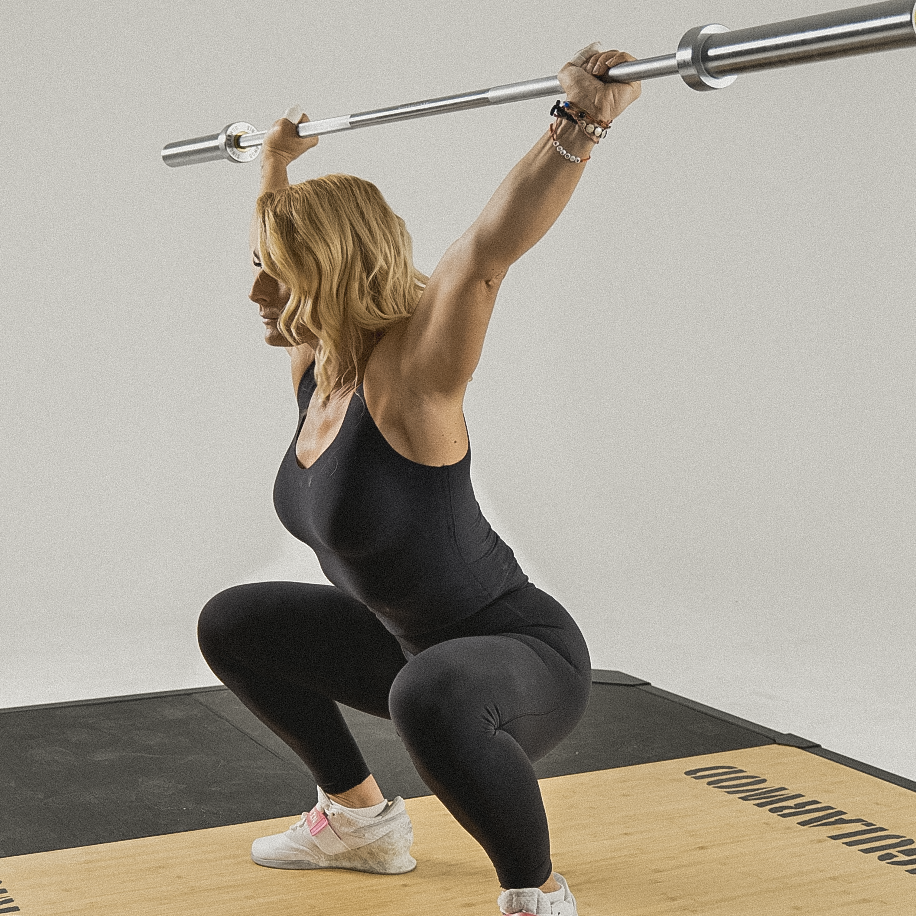
The snatch (or snatch) is the first movement of Olympic weightlifting and, at the same time, one of the most complex and technical gestures in strength training. It requires mobility, coordination, speed, stability and precision in a single continuous sequence.
Performing it correctly not only allows you to lift more weight, but it reduces the risk of injury and improves the efficiency of the movement.

What is the snatch?
The snatch consists of lifting the bar from the floor to above the head in a single movement, receiving it in a deep squat position with the arms fully extended.
According to Greg Everett in Olympic Weightlifting: A Complete Guide for Athletes & Coaches, the snatch is “a movement of power and precision where technique must always prevail over the load.”
Snatch Basics
Before talking about phases, there are universal principles that must be respected:
- The bar moves in a trajectory that is as vertical as possible
- The body adapts to the bar, not the other way around
- Speed is more important than maximum strength
- Final stability defines the quality of the lift
These principles appear recurrently in classic weightlifting literature (Medvedyev, Laputin, Everett).

Snatch phases and key technical guidelines
1. Start Position
Objective: create a stable and efficient foundation.
Guidelines:
- Feet hip-width apart or slightly wider
- Bar over the midfoot
- Neutral back, open chest
- Shoulders slightly in front of the bar
- Relaxed and extended arms
Anatoly Bondarchuk – Transfer of Training in Sports
2. First Pull
From the floor until the bar exceeds the knees.
Keys:
- Maintain back angle
- The bar rises close to the body
- Do not “pull with your arms”
- Controlled rhythm
Common mistake: raising your hips too quickly.
Arkady Vorobyev – Weightlifting
3. Transition (Double Knee Bend)
It is the readjustment of the body to prepare for the explosive phase.
Guidelines:
- Knees move forward slightly
- The torso becomes more vertical
- The bar remains close to the body
This phase is key for mechanical efficiency.
Yuri Verkhoshansky – Special Strength Training Manual for Coaches
4. Second Pull
The most explosive phase of the snatch.
Technical keys:
- Full extension of hips, knees and ankles
- Natural Shrug
- The arms only guide, they do not pull
- Maximum vertical acceleration
“The snatch is not lifted with the arms, it is pushed with the body.”
— Greg Everett
5. Reception (Catch)
Here the quality of the survey is defined.
Guidelines:
- Quick entry under the bar
- Locked arms
- Bar aligned over shoulders, hips and midfoot
- Active core and total stability
Medvedev – A System of Multi-Year Training in Weightlifting

How to warm up the snatch (up → down + down → up)
The basis that Greg Everett lays out is to start with an empty bar, spend some time on your first warm-up weight, and then work your way up in smaller and smaller jumps to the day's weight. (Reference: Catalyst Athletics)
1) Empty bar: drills (you start “up”)
Before loading weight, it is advisable to start with an empty bar to loosen, activate the pattern and reinforce key positions (speed, reception and control).
An effective sequence is to perform 5 repetitions per exercise.
- Snatch high-pull from below the knee.
- Tall muscle snatch.
- Snatch press.
- Drop snatch.
- Overhead squat.
- Snatch from power position.
This “up” approach (power position, tall, drop) reduces variables and allows you to focus on rhythm, precision and stability before working on the full lift.
2) First real weight: from the ground (you start “bottom”)
Once the drills are completed, the next step is to move on to a first warm-up weight to perform the snatch from the ground in more realistic conditions.
As a general reference, that first weight can be around 30–40% of the 1RM.
In this phase, it works well to work with doubles or triples, or with a complex aimed at your main weak point (for example, pull, reception or stability).
To consolidate sensations without tiring, it is advisable to stay there for 2–5 sets, seeking consistency and control.
A common mistake is to accelerate the process and reach high loads without having achieved a real feeling of “being hot” and technically stable.
3) Increase in weights: increasingly smaller increments
As you approach your main weight for the day, increments should be progressively smaller, prioritizing quality over rush.
In snatch, these jumps can end up being 2kg if you need it for technical consistency or confidence.
So... up or down?
The most efficient structure combines both approaches:
Start “up” with an empty bar and drills to establish positions and coordination, and move “down” from the floor as soon as you add the first weight to enter the full pattern with control and repetition.
How to start if you are a beginner?
If you're just starting out, don't start by lifting heavy. The priority should be:
-
Mobility
- Ankles
- Hips
- Shoulders and wrists
-
Technical work in parts
- Snatch pull
- Hang snatch
- Overhead squat
- muscle snatch
-
Light load and conscious repetition
- The technique is learned with quality repetitions
- The weight comes later
As pointed out Bob Takano in Weightlifting Programming:
“Early technical progress determines the athlete's long-term ceiling.”
Common mistakes in the snatch
- Separate the bar from the body
- Pulling with arms too soon
- Lack of full extension
- Instability in reception
- Prioritize weight over technique

Conclusion
The snatch is a movement that requires precision, intention and solid technique. Mastering it is not only about lifting more weight, but about moving better, with control, safety and efficiency in each repetition.
In SINGULARWOD We always look for the best for you, because training with the right material makes a difference. A bar designed for weightlifting offers the correct rebound, accompanies the rhythm of the lift and reduces unnecessary impact on the joints, allowing for a more fluid and safe performance. When technique, movement and material are aligned, progress is real. Training well is training with purpose.