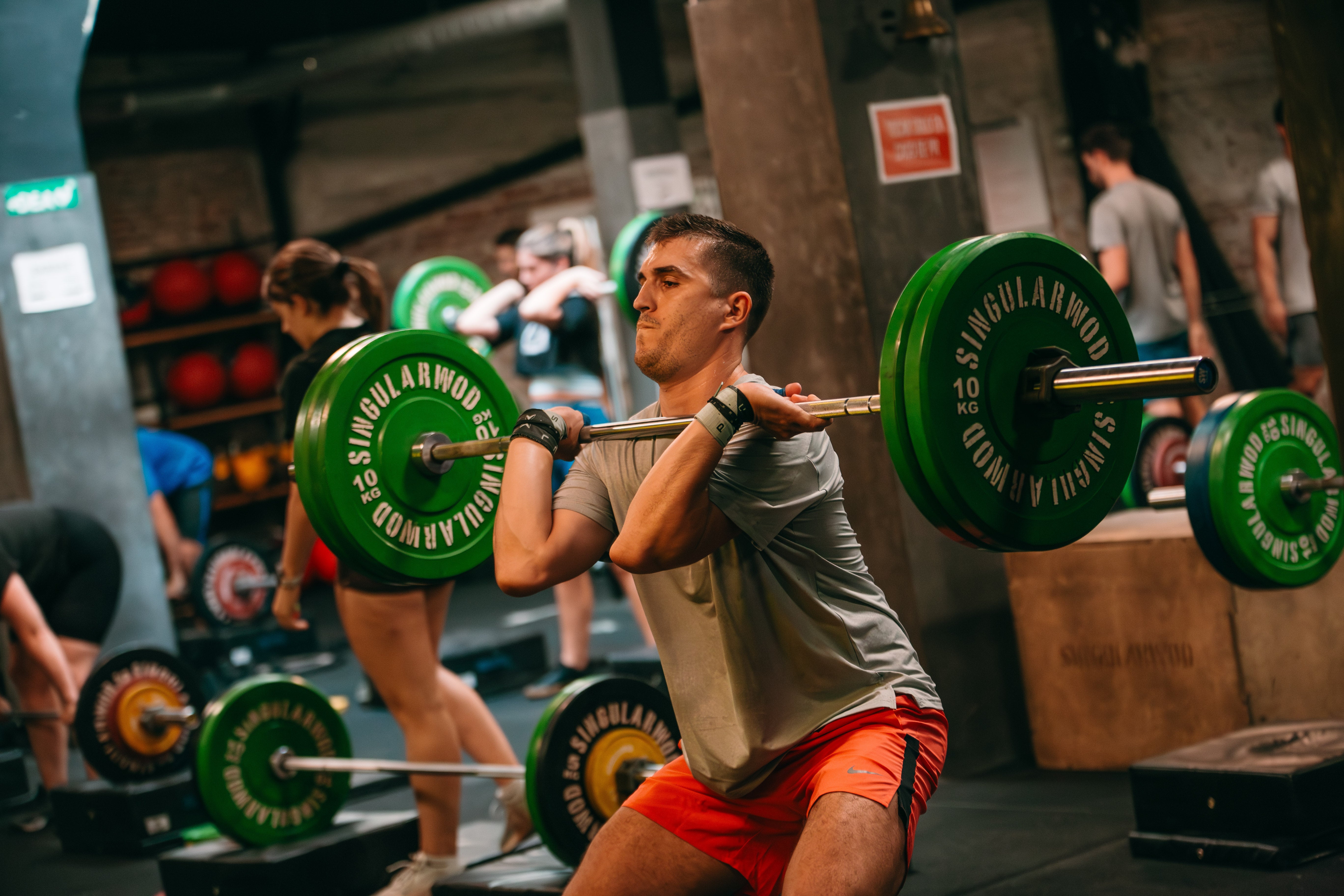
The squat is one of the most natural and essential movements for humans. From standing up from a chair to lifting weights in training, this action is constantly repeated in our daily lives. It is no coincidence that it has become one of the most important exercises in any strength and conditioning program.
But one question continues to divide coaches, athletes and physical therapists: How far should we go down in the squat?

A total movement
The squat is a movement pattern that involves the coordinated action of the ankles, knees, and hips. When performed correctly, it not only strengthens the leg muscles, but also stimulates core stability, joint mobility and proprioception. In the words of McGill (2007, Low Back Disorders), it is a comprehensive exercise for performance and injury prevention.
The science behind the squat
The squat is a multi-joint movement that involves the coordinated action of the ankles, knees and hips. When executed with good technique, it not only strengthens the quadriceps, glutes and hamstrings, but also stimulates core stability and improves joint mobility.
In fact, biomechanics studies (Schoenfeld, 2010; McGill, 2007) highlight that the well-performed squat is a fundamental tool for both sports performance and long-term health.
Types of depth in the squat
Partial squat (more than 90°)
· Easy to execute, especially for beginners.
· It allows heavier loads to be moved, but reduces muscle activation in the glutes and adductors.
· Useful in rehabilitation programs.
Parallel squat (thighs in line with the floor)
· Considered the standard in strength programs.
· Stimulates quadriceps and glutes in a balanced way.
· It offers a good combination of safety and effectiveness.
Deep squat (full squat, beyond parallel)
· Maximizes the activation of glutes, adductors and core.
· Improves ankle and hip mobility.
· According to research compiled by Schoenfeld (2010), it contributes to greater development of functional strength and transferability to sports gestures.

Which is better? Depends on the objective
· Maximum force: The parallel squat is usually more efficient, since it allows greater loads to be handled.
· Hypertrophy and sports performance: The deep squat offers more muscular and neuromuscular benefits.
· Rehabilitation and beginners: The partial squat may be the best initial option.
The most important thing is adapt depth to individual. Factors such as mobility, bone structure, and injury history influence the decision. The NSCA (Essentials of Strength Training and Conditioning) emphasizes that technique and safety should always be prioritized over depth.
The eternal debate: how far to go?
In the world of strength training there is a constant question: what is the optimal squat depth?
· Partial squat (90° or higher): Most used in beginners or in rehabilitation, it allows working with higher loads by reducing the range of motion.
· Parallel squat (thighs in line with the floor): Widely accepted as the standard in strength programs, it balances safety and muscle stimulation.
· Deep squat (full squat): descends beyond parallel, activating glutes and adductors more intensely. According to studies compiled by Schoenfeld (2010, Strength and Conditioning Journal), this range improves mobility and enhances strength in the full range.

Individual factors
There is no single universal answer. The ideal depth will depend on:
· Joint mobility (especially ankles and hips).
· Injury history and structural limitations.
· Training goals: maximum strength, hypertrophy, sports performance or general health.
The NSCA (Essentials of Strength Training and Conditioning, 4th edition) recommends adapting the depth to each individual, prioritizing technique and safety over external load.
So... how far should I go down?
The short answer is: it depends on you.
· If you are a beginner or looking for health and mobility: prioritize deep squats, always within your safe ranges.
· If you are an advanced athlete looking for explosive performance: combine heavy partials with deep partials to get the best of both worlds.
· In all cases: listen to your body, progress with patience and make sure you have the right equipment.
In conclusion
The squat should be understood as an adaptable tool, not as a single rigid model. Beyond seeking an exact number of degrees of flexion, the important thing is to work within the safe and efficient range of motion for each athlete, always ensuring correct spinal alignment and movement control.
In SINGULARWOD We believe that training is built from the base: technique, quality of movement and equipment that allows you to progress safely. Explore our bars, racks and discs on our website designed to take your squats to the next level.